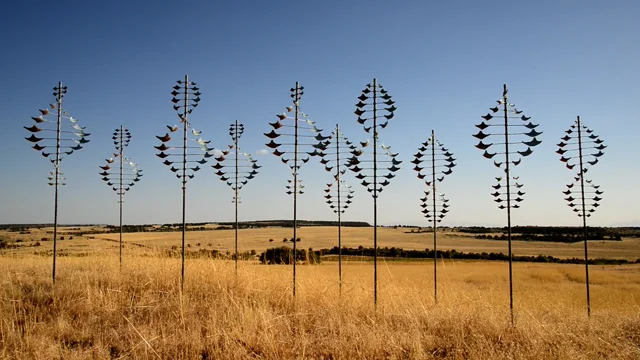
Quotes are drawn from a recorded interview with Michael Heaton of Whitaker Studio, conducted by Jamie Lords in September 2026, lightly edited for clarity and length. Public details about Whitaker Studio's work and reach are drawn from whitakerstudio.com and public app store listings, as noted throughout. This case study is a draft pending Whitaker Studio's review and approval — see the note at the end of this page.
01 — The business
Building the Business Around Moving Art
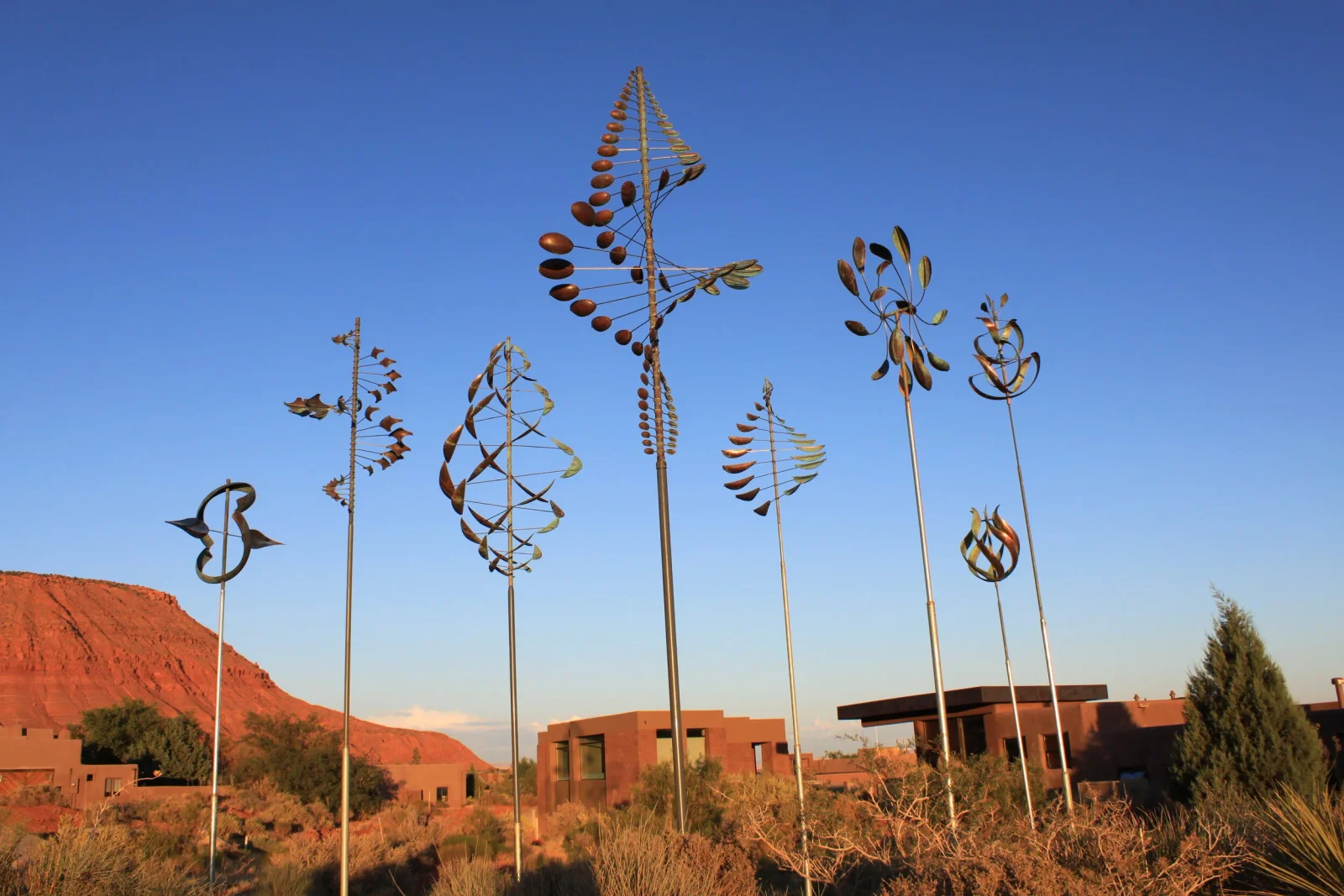
Lyman Whitaker has practiced sculpture for more than 50 years, with the past several decades centered on hand-produced Wind Sculptures — kinetic pieces that respond to changing air currents and must remain visually compelling in motion, outdoors, for years at a time. Whitaker Studio supports that work through a team of artisans, a network of galleries across the United States and abroad, and relationships with private collectors, commercial properties, and public-art commissions.
"Lyman just wants to share the beauty of his art with as many people in the world as he can. And of course, the difficulty is that we can only create so much artwork."
— Michael Heaton, Whitaker Studio
Heaton describes Lyman Whitaker himself as a very gracious and kind guy — the studio is run by Lyman, his wife, and his brother, still very much a family business even as the work has reached galleries and public installations on multiple continents.
02 — The challenge
Art Designed to Move — and a System Designed to Improve Efficiency
A still photograph can document a sculpture's shape, finish, and scale. It cannot communicate the thing that actually defines a Whitaker piece: movement. Early in the relationship, Whitaker Studio had a basic website with a handful of images that, as Heaton puts it, "didn't do it justice."
"Number one, all we had was a website that was pretty basic, with a few pictures, and it just didn't do the artwork justice. When we first created it, we really wanted to create something that was not only representative of the artwork and its movement, but that also let people interact with it."
— Michael Heaton, Whitaker Studio
The need went beyond marketing. Whitaker Studio's internal system — built in Microsoft Access — had evolved around the studio's own production priorities and business-specific records, but it was never built to face the public web. "It was really internal," Heaton says. "It was just really central — an internal system, not one meant to face the web. We didn't have the expertise to keep bad actors out, or the security measures that needed to be in place on that side, either."
The obvious answer would have been to rip it out and start over. Virgo Development took the more practical path: use system integration to build a bridge between the studio's existing system and secure, public-facing experiences, then keep modernizing the foundation over time rather than forcing an immediate, disruptive rebuild.
03 — The partnership
A Decade of Small Revisions, Compounding
Whitaker Studio and Virgo Development have worked together on custom software development since 2016 — Jamie Lords traced the relationship back through old billing records while preparing for this interview, confirming what both sides remembered as "a long time." The first phase paired design sensitivity with the harder problem underneath it: understanding not just what the public should see, but how the studio's existing data and workflows supported the people making, selling, and caring for the art.
"You were willing to continuously revisit and revise, even when they were just minor tweaks that were important to us from an artistic standpoint."
— Michael Heaton, Whitaker Studio
That willingness to sweat small, artistic details became the pattern for everything that followed. Rather than asking Whitaker Studio to reshape its process around off-the-shelf software, Virgo built around the studio's own reality — and once the public website proved the two sides could work together, the partnership expanded into mobile visualization, an internal restoration application, and a more scalable data foundation underneath all of it.
04 — The experience
Bringing Movement to the Public
Video became the way to make motion part of the online experience — giving collectors, galleries, designers, and communities a real sense of how the sculptures move with air, light, and the landscape around them.
"You have helped us bring movement to the public and let them see the art."
— Michael Heaton, Whitaker Studio

That focus on motion shaped the platform underneath it, too. Media needed to load reliably, scale across devices, and stay manageable as the collection and the studio's story kept growing — designed throughout to keep the artwork, not the interface, at the center of attention.
05 — Sales enablement
Visualizing Sculpture in a Real Space
A major sculpture is inseparable from its setting, yet collectors often have to decide before a piece is ever installed. Scale, grouping, orientation, and architectural context are hard to picture from measurements and catalog photography alone — a problem Whitaker Studio's gallery partners felt directly.
"Our distributors really wanted to be able to help clients visualize it in their space when they came in, and give them different ideas."
— Michael Heaton, Whitaker Studio
Virgo Development turned to app development to close that gap, building the Lyman Whitaker Wind Sculptures app. A user starts with a live camera view or an existing photo, selects an individual sculpture or grouping, places it into the scene, captures the result, and shares it — giving galleries and clients a practical, visual way to talk through placement before a piece ever leaves the studio.
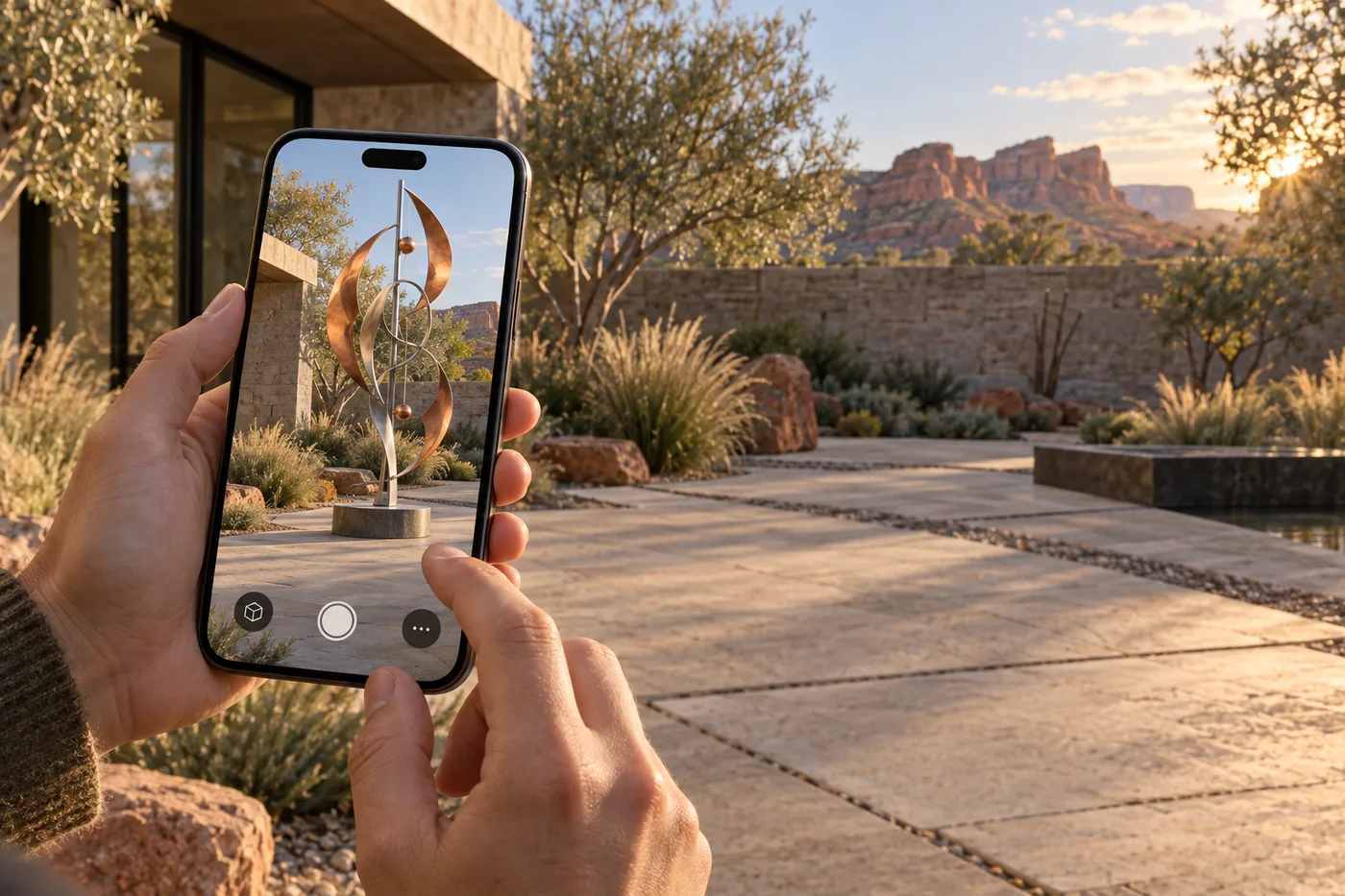
The app also removes a practical bottleneck: a gallery can walk a client through options without waiting on the studio to prepare a custom visualization for every conversation. Whitaker Studio stays available for the expertise only its team can provide, while the app makes early exploration self-directed and immediate.
06 — Service and stewardship
Supporting the Life of the Artwork, Long After Installation
Whitaker Studio's commitment to its artwork continues long after installation. Outdoor kinetic sculptures may eventually require assessment, maintenance, or restoration, and the appropriate response depends on the individual piece, its history, its components, and the conditions it has experienced. Caring for that work requires trained judgment, detailed records, and clear information — not a generic support ticket.
Virgo Development helped build an internal restoration application for Whitaker Studio's artisans. The tool can bring together photographs, artwork history, ownership information, gallery context, an initial assessment, and the steps needed to move the work forward. Different team members can contribute their specialties, so one person's assessment becomes an organized starting point for the next person's work.
"They have some of the skills needed to help restore the artwork. One person can come in and assess what a piece needs, and then someone else can take that initial assessment, start addressing those issues, and restore the parts they can — and slowly we work on getting that piece back to the client or customer."
— Michael Heaton, Whitaker Studio
This is less about repair volume than stewardship. A sculpture may stay in place for decades, pass to a new owner, or return to the studio through a gallery relationship — and preserving that context helps the studio respond consistently while keeping its artisans' judgment, not a ticketing system, at the center of the process.
07 — A connected collection
From Individual Tools to a Living Digital Record
Over time, the separate projects have started reinforcing each other. The website presents the artwork and its motion. The visualization app helps place a sculpture into a future setting. The service application preserves history after installation. None of it is one monolithic platform — it's a growing set of connected capabilities built around the real moments people encounter the art: discovering it, seeing it move, imagining it in place, buying it through a gallery, and caring for it afterward.
Both are still live today: the Lyman Whitaker Wind Sculptures visualization app and the separate internal Wind (Whitaker Studio) restoration tool, each credited to Virgo Development in their app-store listings.
08 — Working with Virgo
A Decade of Trust and New Ideas
"You guys really are amazing. I've appreciated working with every single one of the people I've worked with out there — you, Adam, John, Nikki, and even Dan, way back in the day. You guys are friendly, you're kind, and you're very responsive, especially when it matters, which is important."
— Michael Heaton, Whitaker Studio
Heaton points to that responsiveness — and to having a partner willing to work through an idea rather than fold it into something they'd already built for someone else — as what has kept the relationship going since 2016. His own role has shifted as the systems have matured: less time reacting to what's breaking, more time thinking about how the website, media, galleries, and collection information come together as one coherent marketing experience.
09 — What comes next
Keeping the Experience Dynamic
The mission ahead is the same one that started the work: help more people experience the sculpture. Heaton describes a studio hoping to bring the art into more public spaces, help collectors visualize it in personal settings, and — with an eye on where AI is heading — get more direct control over how its digital pages look and feel, and change over time.
"We're just hoping to continue that mission of sharing the artwork and letting people experience what it's about — bringing it to more public spaces, where the community at large gets to experience it, feel it, walk through it, and engage with it."
— Michael Heaton, Whitaker Studio
For Virgo, that future runs through the same principle that has shaped the partnership since 2016: technology should extend Whitaker Studio's reach without flattening the artwork into content or replacing the judgment of the people who make and represent it.
10 — Common questions
Quick Answers
What did Virgo Development build for Whitaker Studio?
Virgo Development has supported Whitaker Studio with web development, legacy-system integration, a mobile sculpture-visualization app, an internal restoration application, and a more scalable data foundation connecting all of it.
Why was Whitaker Studio's original system difficult to modernize?
Whitaker Studio's Microsoft Access system had evolved around highly specialized production and business workflows. It was valuable internally but was never built for secure public web access, so Virgo created a practical bridge rather than forcing an immediate rebuild.
How does the Lyman Whitaker Wind Sculptures app work?
A user starts with a live camera view or an existing photo, selects a sculpture or grouping, places it into the scene, captures the result, and can share the image to support a placement or sales conversation.
What does Whitaker Studio's internal restoration application do?
It helps trained Whitaker Studio artisans organize an assessment and the information needed to guide restoration work, including photographs, artwork history, ownership context, gallery information, and recommended next steps.
How long have Whitaker Studio and Virgo Development worked together?
The partnership began in 2016 and has continued as both the studio's digital needs and Virgo Development's capabilities have evolved.
Who built Whitaker Studio's website, app, and internal software?
Virgo Development, a custom software and web development company based in St. George, Utah, has built and maintained Whitaker Studio's website, mobile visualization app, and internal restoration tool since 2016.
You guys really are amazing. I've appreciated working with every single one of the people I've worked with out there. You're friendly, you're kind, and you're very responsive, especially when it matters, which is important.

Curious what all of this looks like in practice? Explore Whitaker Studio to see Lyman Whitaker's Wind Sculptures, gallery representation, videos, and public installations in motion.
Ready to build the software behind your own hands-on, specialized business? Book a Discovery Call with me and the team.
Jamie Lords ↗ LinkedIn is CEO of Virgo Development and teaches Business and Marketing at Southern New Hampshire University. This is the second in an ongoing case study series documenting real Virgo Development client partnerships. Quotes are drawn from a recorded interview with Whitaker Studio's Michael Heaton conducted in September 2026, lightly edited for clarity and length. This draft — including every quote, the hero and mobile-visualization illustrations, the Kwavasa Roundabout video feature, and Lyman Whitaker's signature — is pending Whitaker Studio's review and approval before publication.